
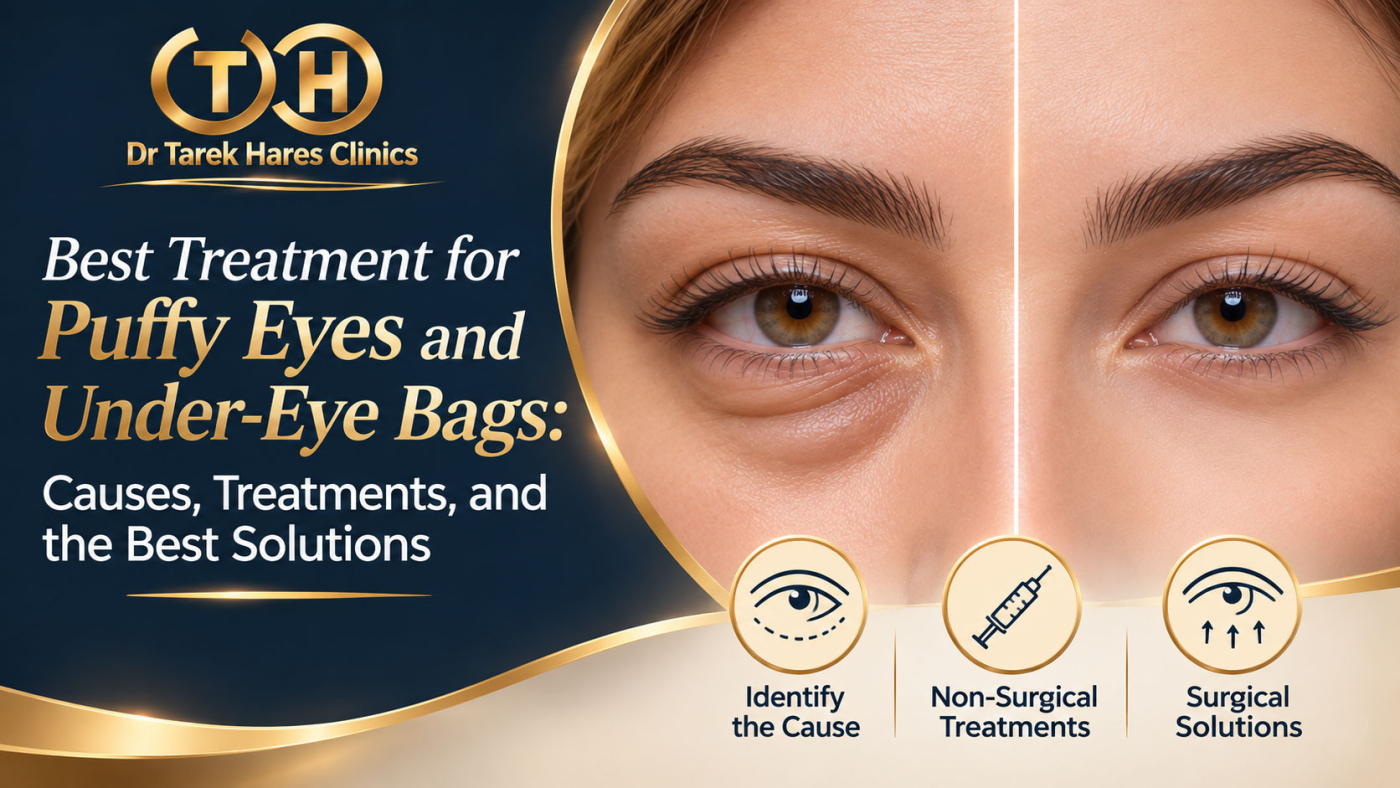
Best Treatment for Puffy Eyes and Under-Eye Bags: Causes, Treatments, and the Best Solutions
Puffy eyes and under-eye bags are among the most common aesthetic concerns affecting both men and women.
Some people notice swelling beneath their eyes after waking up, while others experience persistent bags that gradually become more noticeable with age.
Although these changes are often harmless, they can make the face appear tired, older, or less refreshed.
The important thing to understand is that not all under-eye bags have the same cause, and not all patients need surgery.
Some cases are associated with temporary fluid retention, allergies, or lifestyle factors. Others result from changes in orbital fat, skin elasticity, and the supporting structures around the lower eyelids.
Choosing the right treatment requires identifying the underlying cause.
Dr. Tarek AbdelHaris focuses on eye and eyelid aesthetics, helping patients understand the anatomical factors behind their concerns and the available treatment options.
In this guide, we explore why under-eye bags develop, how to distinguish between different types of puffiness, and when lower eyelid blepharoplasty may be appropriate.
What Are Under-Eye Bags?
Under-eye bags refer to visible puffiness, swelling, or bulging beneath the lower eyelids.
They can appear as:
- Soft swelling beneath the eyes.
- Prominent fatty bulges.
- Loose or wrinkled lower eyelid skin.
- Shadows between the lower eyelid and cheek.
- A hollow or uneven transition below the eyes.
Some patients have one dominant feature, while others have a combination.
Understanding the difference is essential because each problem may require a different treatment.
What Causes Puffy Eyes and Under-Eye Bags?
1. Aging and loss of skin elasticity
The skin around the eyes is naturally thin and delicate.
As people age, collagen and elastin gradually decrease, while the supporting structures around the eyelids may weaken.
This can contribute to:
- Loose lower eyelid skin.
- Fine lines and wrinkles.
- Changes in lower eyelid contour.
- More visible underlying fat.
2. Protruding orbital fat
One of the important anatomical causes of persistent under-eye bags is the forward prominence of orbital fat.
Fat normally surrounds the eye and provides cushioning and protection.
When the supporting tissues weaken or change, fat compartments may become more prominent, producing visible bulges beneath the eyes.
This type of under-eye bag may not respond significantly to lifestyle changes or cosmetic creams.
3. Fluid retention
Temporary fluid accumulation can produce morning puffiness.
Contributing factors may include:
- Excessive salt consumption.
- Poor sleep.
- Sleeping position.
- Allergies.
- Certain medications.
- General fluid-retention conditions.
This type of swelling may fluctuate throughout the day.
4. Genetic factors
Some people naturally have prominent under-eye bags due to inherited facial anatomy.
They may develop visible puffiness even at a relatively young age.
5. Allergies and inflammation
Allergic reactions can cause swelling, itching, redness, and irritation around the eyes.
Repeated eye rubbing may further irritate the delicate eyelid skin.
Persistent or painful swelling should be medically assessed rather than treated as a cosmetic problem.
6. Dark circles and tear-trough hollows
Not every dark area beneath the eyes is a fat bag.
Sometimes the appearance results from hollowing, pigmentation, thin skin, or shadows created by facial anatomy.
This is an important distinction because removing fat will not necessarily correct pigmentation or volume loss.
How to Identify the Type of Under-Eye Problem
| Condition | Typical appearance | Possible approach |
|---|---|---|
| Temporary puffiness | Fluctuating swelling, often worse in the morning | Address fluid retention and triggers |
| Prominent orbital fat | Persistent rounded bulges | Assessment for lower blepharoplasty |
| Loose skin | Wrinkles and excess skin | Skin-directed treatment or surgery |
| Tear-trough hollowing | Indented area below the eye | Selected volume-restoration options |
| Dark circles | Brown, blue, or shadowed appearance | Treat the underlying cause |
| Allergy-related swelling | Itching, redness, fluctuating swelling | Allergy assessment and treatment |
A specialist examination is important because several of these conditions can occur together.
Best Treatments for Puffy Eyes and Under-Eye Bags
There is no single treatment that is best for everyone.
The correct option depends on whether the problem is caused by fluid retention, excess skin, protruding fat, volume loss, pigmentation, or a combination.
1. Home Remedies for Temporary Puffy Eyes
Inilah 18 Manfaat Mengompres Mata dengan Air Es untuk Atasi Mata Bengkak! – Repository
For mild puffiness associated with temporary fluid retention, simple measures may help.
Cold compresses
Applying a clean, cool compress gently around the eyes may temporarily reduce swelling.
Avoid applying ice directly to the skin.
Improve sleep quality
Inadequate sleep can make puffiness and dark circles more noticeable.
Maintaining a regular sleep schedule may help improve the appearance of the eye area.
Reduce excessive salt intake
High salt consumption can contribute to fluid retention in some individuals.
A balanced diet and adequate hydration are useful general health measures.
Manage allergies
Treating allergies and avoiding known triggers can help reduce allergy-related swelling.
Patients should avoid rubbing their eyes.
Stop smoking
Smoking can accelerate skin aging and contribute to changes in skin quality.
Stopping smoking supports general health and may help preserve skin condition.
These measures may improve temporary swelling, but they cannot remove persistent protruding orbital fat.
2. Eye Creams and Topical Treatments
Several cosmetic products are marketed for under-eye puffiness.
Their effectiveness depends on the cause.
Some ingredients may provide temporary cosmetic improvements:
- Caffeine-based products may temporarily reduce the appearance of puffiness.
- Moisturizers may improve skin hydration.
- Retinoid-based products may help selected signs of photoaging, but the delicate eyelid area requires careful product selection.
- Sunscreen helps protect the surrounding skin from ultraviolet damage.
However, topical products cannot reliably remove prominent orbital fat or correct significant lower eyelid skin laxity.
Patients with sensitive eyes should discuss product use with an eye-care professional.
3. Non-Surgical Treatments for Under-Eye Bags
Surgical vs. Non-Surgical Eye Bag Fat Treatments | Perfect Medical
Some patients may benefit from non-surgical treatments.
Dermal fillers
Carefully selected hyaluronic acid fillers may improve certain tear-trough hollows.
They do not remove orbital fat.
The under-eye area is anatomically complex and has a risk of prolonged swelling, visible irregularities, vascular complications, and rare vision-threatening complications.
Therefore, treatment requires an experienced and appropriately qualified medical professional.
Laser skin resurfacing
Selected laser treatments may improve:
- Fine wrinkles.
- Skin texture.
- Certain pigmentation concerns.
- Some signs of sun damage.
They do not correct every cause of under-eye bags.
Chemical peels
Certain carefully selected peels may improve superficial skin texture and pigmentation.
They are not suitable for every patient, and the thin eyelid skin requires particular caution.
4. Lower Eyelid Blepharoplasty: A Surgical Solution
Tear Trough Treatment Options | EyePlastics
For patients with persistent under-eye bags caused by prominent orbital fat or excess lower eyelid skin, lower eyelid blepharoplasty may be an appropriate treatment.
The procedure aims to improve the lower eyelid contour while maintaining proper eyelid position and function.
Depending on the anatomy, the surgeon may:
- Remove selected excess skin.
- Reposition protruding fat.
- Preserve or redistribute orbital fat.
- Address selected supporting tissue changes.
- Combine the procedure with additional techniques when indicated.
Transconjunctival Lower Blepharoplasty
In this approach, the surgeon accesses the lower eyelid fat through the inner surface of the eyelid.
It is commonly considered in patients with prominent fat pads and relatively good skin elasticity.
One advantage is that there is no external skin incision.
Transcutaneous Lower Blepharoplasty
In selected patients with excess skin and other lower eyelid changes, an incision may be placed just below the eyelashes.
This allows the surgeon to address the skin and deeper tissues as appropriate.
The choice depends on the patient’s anatomy and risk factors.
Who Is a Good Candidate for Lower Eyelid Surgery?
Patients who may benefit include those with:
- Persistent under-eye fat bulges.
- Age-related lower eyelid changes.
- Excess lower eyelid skin.
- A tired appearance associated with structural changes.
- Good general health or appropriately managed medical conditions.
- Realistic expectations.
Patients with dry eyes, lower eyelid laxity, thyroid eye disease, previous eyelid surgery, or other ocular conditions may require additional assessment.
What Happens During Lower Eyelid Blepharoplasty?
Before surgery
The surgeon evaluates the lower eyelid, orbital fat, skin quality, cheek support, eyelid position, and ocular surface.
The treatment plan is designed around the patient’s anatomy.
During surgery
The procedure is performed under an appropriate anesthetic plan.
Depending on the technique, the surgeon accesses the lower eyelid through the inner surface or beneath the eyelashes.
Fat may be removed conservatively or repositioned to improve the contour.
After surgery
Patients receive instructions about eye care, medication, cold compresses, activity restrictions, and follow-up.
Recovery After Under-Eye Bag Surgery
Recovery varies between individuals.
Common temporary effects include:
- Swelling.
- Bruising.
- Mild discomfort.
- Temporary tightness.
- Temporary changes in sensation.
Many patients experience noticeable improvement over the first one to two weeks, while residual swelling may take longer to settle.
Patients should follow their surgeon’s instructions and avoid strenuous activity until cleared.
Sudden vision changes, severe pain, or rapidly increasing swelling require immediate medical attention.
What Are the Risks of Lower Eyelid Surgery?
Potential complications include:
- Bleeding.
- Infection.
- Scarring.
- Dry eye symptoms.
- Lower eyelid retraction.
- Eyelid asymmetry.
- Persistent or recurrent puffiness.
- Hollowing from excessive fat removal.
- Changes in eyelid position.
- Need for revision surgery.
- Rare vision-threatening complications.
Proper patient selection and conservative surgical planning are important.
Can Under-Eye Bags Return After Surgery?
Surgery can produce long-lasting improvement, but it does not stop aging.
Changes in skin elasticity, facial volume, and supporting tissues may continue over time.
Some patients may develop new puffiness or contour changes years after surgery.
The likelihood depends on individual anatomy and the original treatment.
Is Under-Eye Bag Surgery Better Than Fillers?
Neither treatment is universally better.
The correct choice depends on the underlying problem.
- Prominent fat bags: Lower eyelid blepharoplasty may be more appropriate.
- Tear-trough hollowing: Selected patients may benefit from volume restoration.
- Skin wrinkles: Skin-directed treatments may be considered.
- Temporary fluid swelling: Lifestyle adjustments and treatment of underlying triggers may be sufficient.
In some cases, fillers are inappropriate or may worsen existing puffiness.
A professional examination helps determine the safest and most appropriate approach.
Frequently Asked Questions About Puffy Eyes and Under-Eye Bags
1. What is the most effective treatment for under-eye bags?
For persistent bags caused by protruding orbital fat, lower eyelid blepharoplasty may provide significant improvement. Other causes require different treatments.
2. Can under-eye bags disappear naturally?
Temporary puffiness may improve with better sleep, reduced salt intake, allergy management, and other lifestyle changes. Structural fat protrusion generally does not disappear through home remedies.
3. Does drinking more water remove eye bags?
Adequate hydration supports general health, but drinking additional water does not remove protruding orbital fat.
4. Can eye creams remove under-eye bags?
Eye creams may improve hydration or temporarily reduce the appearance of puffiness. They cannot surgically correct prominent fat pads.
5. Is lower eyelid surgery permanent?
Results can be long-lasting, although the natural aging process continues.
6. Does lower eyelid surgery leave scars?
The transconjunctival approach has no external skin incision. The transcutaneous approach creates an incision usually placed just below the eyelashes, where scars often become less noticeable with healing.
7. How long does recovery take?
Many patients feel comfortable returning to routine activities within one to two weeks, although full healing takes longer.
8. Can young people develop under-eye bags?
Yes. Genetic factors and individual orbital anatomy can cause prominent under-eye bags in younger adults.
9. Can fillers remove eye bags?
Fillers do not remove fat bags. They may help selected patients with tear-trough hollowing, but treatment must be carefully planned.
10. How do I know whether I need surgery?
An examination can determine whether the problem is caused by fat protrusion, excess skin, fluid retention, hollowing, pigmentation, or another condition.
Why Choose Dr. Tarek AbdelHaris for Under-Eye Bag Treatment?
The lower eyelid is a delicate anatomical structure that plays an important role in protecting the eye.
Treatment should address the patient’s aesthetic concerns while maintaining:
- Normal eyelid position.
- Comfortable blinking.
- Proper eyelid closure.
- Ocular surface health.
- Natural lower eyelid contours.
Dr. Tarek AbdelHaris emphasizes individualized evaluation and treatment planning for patients seeking eyelid aesthetic procedures.
Book Your Consultation
Persistent under-eye bags can have several different causes. Choosing treatment without identifying the underlying problem may lead to disappointing results.
Schedule a consultation with Dr. Tarek AbdelHaris to determine which treatment options may be suitable for your lower eyelid concerns.
A wonderful serenity has taken possession of my entire soul, like these sweet mornings of spring which I enjoy with my whole heart. I am alone, and feel the charm of existence in this spot, which was created for the bliss of souls like mine. I am so happy.
my dear friend, so absorbed in the exquisite sense of mere tranquil existence, that I neglect my talents.
I feel that I never was a greater artist than now. When, while the lovely valley teems with vapour around me, and the meridian sun strikes the upper surface of the impenetrable foliage of my trees, and but a few stray gleams steal into the inner sanctuary.