
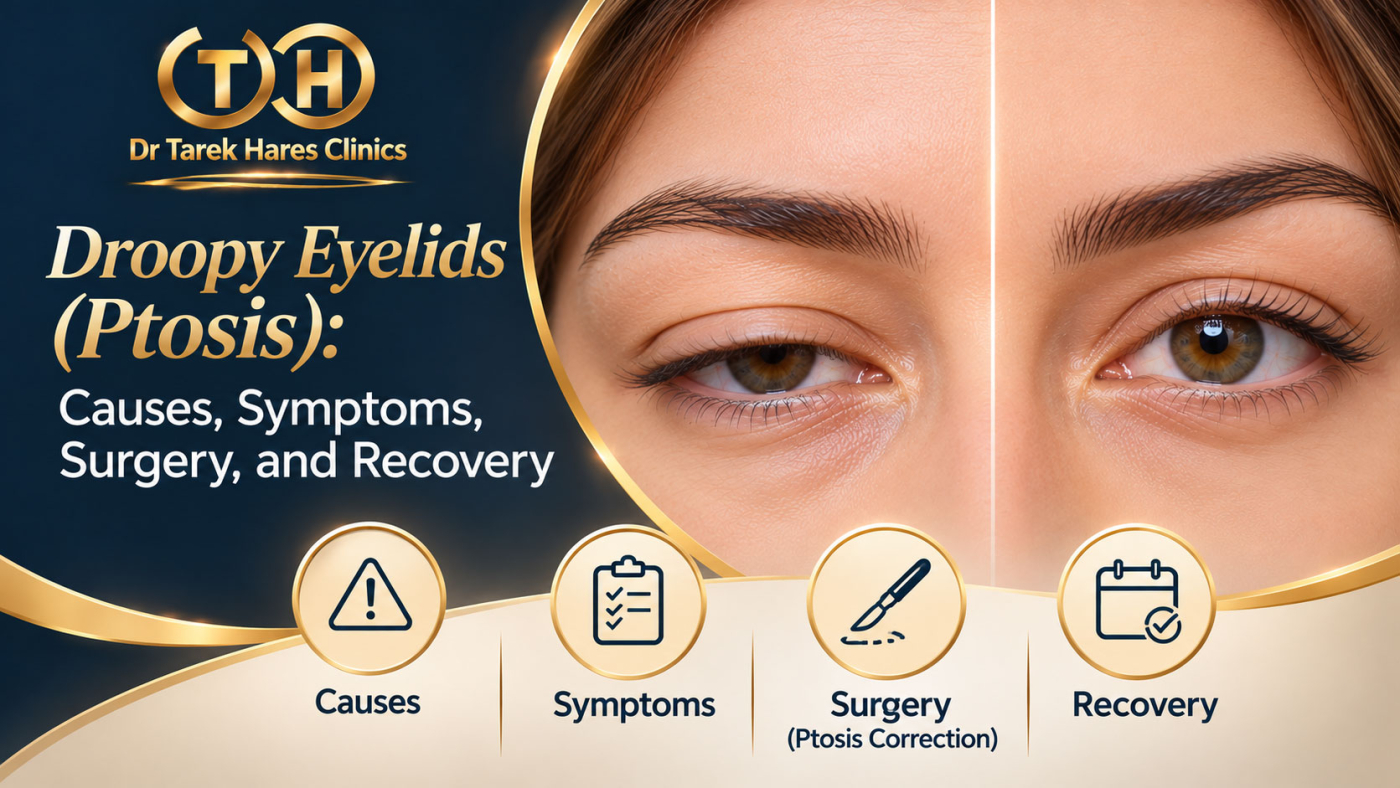
Droopy Eyelids (Ptosis): Causes, Symptoms, Surgery, and Recovery
Droopy Eyelids (Ptosis): Causes, Symptoms, Surgery, and Recovery
The position of the upper eyelids plays an important role in both facial appearance and visual function.
When the upper eyelid falls lower than its normal position, the condition is known as ptosis, or droopy eyelid.
Ptosis can affect one eye or both eyes. In mild cases, it may mainly create an asymmetrical or tired appearance. In more severe cases, the eyelid may partially cover the pupil and interfere with vision.
Unlike ordinary excess eyelid skin, true ptosis is usually associated with a problem involving the muscles, tendons, nerves, or other structures responsible for lifting the upper eyelid.
This distinction is essential because the treatment for ptosis is different from standard cosmetic eyelid surgery.
Dr. Tarek AbdelHaris specializes in eye surgery and eyelid aesthetics, with an individualized approach to evaluating eyelid position, function, and appearance.
This comprehensive guide explains the causes of ptosis, its symptoms, diagnostic methods, available treatments, and what patients should expect from ptosis surgery.
What Is Ptosis?
Ptosis is the medical term for an abnormally low position of the upper eyelid.
The upper eyelid is normally maintained in an elevated position through the coordinated action of several anatomical structures, particularly the levator palpebrae superioris muscle and its tendon, known as the levator aponeurosis.
A second muscle, called Müller’s muscle, also contributes to upper eyelid elevation.
When these structures do not function properly, the upper eyelid may descend.
Depending on the severity, ptosis can:
- Make one eye appear smaller than the other.
- Create an asymmetrical facial appearance.
- Partially cover the pupil.
- Reduce the upper visual field.
- Cause difficulty keeping the eyes open.
- Contribute to forehead muscle strain.
Ptosis may be congenital, meaning present from birth, or acquired later in life.
What Causes Droopy Eyelids?
Several medical and anatomical conditions can lead to ptosis.
1. Age-Related Ptosis
Age-related ptosis is one of the common forms of acquired ptosis.
As people age, the tendon connecting the levator muscle to the eyelid may stretch, thin, or become detached from its normal attachment.
This can reduce the ability of the muscle to maintain the eyelid in its normal position.
Patients may notice:
- Gradual drooping of the upper eyelid.
- Increasing eyelid asymmetry.
- Difficulty keeping the eyes fully open.
- A tired or sleepy appearance.
This type of ptosis is often referred to as aponeurotic ptosis.
2. Congenital Ptosis
Congenital ptosis is present at birth or develops during early childhood.
It is commonly associated with abnormal development of the levator muscle.
In children, severe ptosis can interfere with normal visual development.
If the eyelid covers the visual axis, it may contribute to amblyopia, commonly called lazy eye.
Children with suspected ptosis should receive an appropriate ophthalmic examination.
Treatment timing depends on the severity and the risk to visual development.
3. Neurogenic Ptosis
Neurogenic ptosis occurs when the nerves controlling eyelid movement are affected.
Possible causes include:
- Third cranial nerve palsy.
- Horner syndrome.
- Certain neurological conditions.
- Nerve injury.
Some neurological causes of ptosis may be associated with other symptoms, including abnormal pupil size, double vision, or eye movement problems.
Important medical warning: Sudden-onset drooping eyelid, particularly when accompanied by double vision, unequal pupils, severe headache, or neurological symptoms, requires urgent medical evaluation. It should not be treated as a cosmetic concern without investigating the cause.
4. Myogenic Ptosis
Myogenic ptosis results from conditions affecting the muscles responsible for eyelid elevation.
Examples include:
- Myasthenia gravis.
- Certain muscular disorders.
- Some congenital muscle conditions.
Patients may experience fluctuating eyelid drooping, particularly when muscle weakness changes throughout the day.
5. Traumatic Ptosis
Traumatic ptosis can develop following an injury to the eyelid, levator muscle, tendon, or surrounding tissues.
The degree of drooping depends on the nature and severity of the injury.
Some patients require surgical reconstruction, while others may benefit from observation and treatment of associated conditions.
6. Post-Surgical Ptosis
Some patients develop ptosis following eye surgery, particularly after procedures involving the eye or surrounding structures.
This may occur because of stretching, inflammation, or injury involving the levator mechanism.
The timing and cause must be evaluated before considering corrective surgery.
What Are the Symptoms of Ptosis?
The symptoms vary depending on the degree of eyelid drooping and the underlying cause.
Common symptoms include:
- One upper eyelid appearing lower than the other.
- Reduced upper visual field.
- Difficulty keeping the eyes open.
- A tired or sleepy appearance.
- Frequent eyebrow raising to compensate for eyelid drooping.
- Forehead fatigue or discomfort.
- Head tilting backward to improve vision.
- Difficulty with reading or other daily activities.
Some patients mainly notice the cosmetic difference, while others experience significant functional problems.
What Is the Difference Between Ptosis and Excess Upper Eyelid Skin?
This is one of the most important questions in eyelid surgery.
Ptosis and excess upper eyelid skin can look similar, but they are different anatomical conditions.
| Feature | Ptosis | Excess eyelid skin |
|---|---|---|
| Main problem | Low eyelid margin | Redundant skin |
| Main anatomical structure | Levator mechanism or other eyelid-lifting structures | Upper eyelid skin and supporting tissues |
| Common treatment | Ptosis correction surgery | Upper blepharoplasty |
| Effect on pupil | May cover part of the pupil | Usually does not directly lower the eyelid margin |
| Functional impact | Can obstruct the visual field | Can obstruct vision when severe |
Some patients have both conditions.
In such cases, the surgeon may recommend ptosis correction together with upper blepharoplasty, either in one operation or in stages.
Correct diagnosis is essential to avoid performing cosmetic skin removal when the underlying problem is a low eyelid margin.
How Is Ptosis Diagnosed?
A complete examination is required to identify the cause and determine the most appropriate treatment.
1. Medical history
The doctor may ask about:
- When the eyelid drooping started.
- Whether the condition is getting worse.
- Previous eye surgery.
- History of eye injuries.
- Fluctuating symptoms.
- Double vision.
- Neurological symptoms.
- Family history of ptosis.
2. Eyelid position measurement
The surgeon evaluates the position of the upper eyelid relative to the pupil.
One important measurement is the margin reflex distance 1 (MRD1).
It measures the distance between the corneal light reflex and the upper eyelid margin.
3. Levator muscle function
The doctor measures how far the upper eyelid moves when the patient looks downward and then upward while brow movement is controlled.
This helps determine the function of the levator muscle.
4. Eyelid symmetry
Both eyes are examined to identify differences in eyelid position and movement.
5. Ocular examination
The examination may include:
- Visual acuity assessment.
- Pupil evaluation.
- Eye movement assessment.
- Tear-film evaluation.
- Eyelid closure.
- Ocular surface examination.
6. Additional investigations
Some patients may require further investigations depending on the suspected cause.
For example, patients with fluctuating ptosis or associated neurological signs may need evaluation for an underlying neurological or muscular condition.
Visual field testing may also be useful when eyelid drooping interferes with vision.
What Is the Best Treatment for Ptosis?
Treatment depends on the underlying cause, severity, muscle function, and associated eye conditions.
Not every patient requires surgery.
However, surgery is commonly considered when ptosis significantly affects appearance or visual function and the patient is an appropriate candidate.
Ptosis Surgery: How Is Droopy Eyelid Correction Performed?
Evaluation and management of acquired ptosis
Ptosis surgery aims to elevate the upper eyelid by improving the function or attachment of the structures responsible for lifting it.
The surgical technique is selected according to levator muscle function, severity of ptosis, and individual anatomy.
1. Levator Advancement or Resection
This is a commonly used approach for patients with suitable levator muscle function.
The surgeon accesses the levator mechanism through an incision, usually placed in the natural upper eyelid crease.
The levator aponeurosis may be advanced or tightened to improve its attachment to the eyelid.
This allows the upper eyelid to sit in a higher position.
The amount of correction is carefully planned to achieve an appropriate eyelid height and contour.
2. Müller Muscle-Conjunctival Resection
In selected patients, a posterior approach may be appropriate.
This technique involves adjusting Müller’s muscle and associated conjunctival tissue to elevate the upper eyelid.
Patient selection is important, and the technique is not suitable for every type of ptosis.
3. Frontalis Sling Surgery
Frontalis sling surgery may be considered in patients with poor levator function.
The procedure connects the upper eyelid to the frontalis muscle using an appropriate sling material or tissue.
The forehead muscle then helps elevate the eyelid.
This technique is particularly relevant in selected patients with severe congenital ptosis.
Patients undergoing frontalis sling procedures may need to understand that eyelid closure can be incomplete, making ocular surface protection and lubrication especially important.
Is Ptosis Surgery Different from Blepharoplasty?
Yes.
Ptosis surgery corrects the position of the upper eyelid margin.
Blepharoplasty removes or manages excess eyelid skin and selected tissue changes.
The two procedures can sometimes be performed together.
However, a patient who has true ptosis may not achieve the desired eyelid position through skin removal alone.
A proper examination is necessary before selecting the procedure.
Who Is a Good Candidate for Ptosis Surgery?
Potential candidates include patients who:
- Have persistent drooping of the upper eyelid.
- Experience reduced upper visual field.
- Have eyelid asymmetry caused by ptosis.
- Experience difficulty keeping the eyes open.
- Have stable underlying medical conditions.
- Have realistic expectations about surgical results.
The underlying cause must be identified before surgery.
For patients with neurological or muscular conditions, the medical condition may need treatment or stabilization before surgical correction is considered.
What Happens Before Ptosis Surgery?
Preparation is an important part of achieving a suitable surgical result.
The doctor will:
- Review the patient’s medical history.
- Assess the eyelid position.
- Measure levator muscle function.
- Examine the pupils and eye movements.
- Assess tear-film function and eyelid closure.
- Discuss the expected outcome and possible risks.
- Determine the most appropriate surgical technique.
Patients should inform the surgeon about all medications, supplements, allergies, and previous procedures.
Recovery After Ptosis Surgery
Before and After Upper Eyelid Surgery: What to Expect from Results and Recovery | Leva Medical
Recovery varies depending on the surgical technique and individual healing.
Common temporary effects include:
- Swelling.
- Bruising.
- Mild discomfort.
- Temporary asymmetry.
- Tightness around the eyelid.
- Temporary changes in eyelid sensation.
First few days
Swelling and bruising are common. Patients should follow instructions regarding cold compresses, prescribed medication, and activity restrictions.
First one to two weeks
Swelling generally begins to improve, and patients may gradually return to routine activities when cleared by their surgeon.
Following weeks
Eyelid position and symmetry may continue to settle.
Final assessment should take place after sufficient healing.
Important recovery instructions
Patients may be advised to:
- Avoid rubbing the eyes.
- Use prescribed eye drops and ointments.
- Keep the surgical area clean.
- Avoid strenuous physical activity initially.
- Attend scheduled follow-up visits.
- Use appropriate lubrication when recommended.
Some patients, particularly those with incomplete eyelid closure after surgery, require additional ocular surface protection.
Severe pain, sudden visual changes, double vision, or rapidly increasing swelling should be assessed urgently.
What Are the Risks of Ptosis Surgery?
Ptosis correction is a delicate procedure, and complications may occur.
Potential risks include:
- Under-correction.
- Over-correction.
- Eyelid asymmetry.
- Irregular eyelid contour.
- Difficulty closing the eye completely.
- Dry eye symptoms.
- Exposure-related corneal problems.
- Infection.
- Bleeding.
- Recurrence of ptosis.
- Need for additional surgery.
The surgeon must balance eyelid elevation with proper blinking and eye protection.
Can Ptosis Come Back After Surgery?
Yes, recurrence is possible.
The likelihood depends on the cause of ptosis, tissue quality, surgical technique, and individual healing.
Some patients may develop recurrent drooping years after surgery because of ongoing tissue changes or progression of the underlying condition.
Revision surgery may be considered after a thorough assessment.
How Long Do Ptosis Surgery Results Last?
Many patients experience long-lasting improvement.
However, results vary depending on the cause of ptosis and the condition of the levator mechanism.
Congenital, age-related, neurogenic, and myogenic ptosis have different treatment considerations and prognoses.
Regular follow-up is important to monitor eyelid position and ocular surface health.
Frequently Asked Questions About Ptosis Surgery
1. Can droopy eyelids be corrected without surgery?
Some acquired causes may improve when the underlying condition is treated. Selected temporary ptosis cases may be managed without surgery. However, persistent structural ptosis often requires surgical correction when treatment is indicated.
2. Is ptosis surgery considered cosmetic surgery?
It can have both functional and aesthetic benefits. When drooping interferes with vision, surgery may be medically indicated. In other cases, the primary goal may be improving eyelid symmetry and appearance.
3. Is ptosis surgery painful?
The procedure is performed using an appropriate anesthesia plan. Some temporary discomfort, swelling, and tightness may occur during recovery.
4. How long does ptosis surgery take?
The duration depends on the technique, complexity, and whether additional procedures are performed.
5. Can ptosis affect vision?
Yes. Significant upper eyelid drooping can obstruct the upper visual field and interfere with daily activities.
6. Can both eyes be corrected at the same time?
Yes, when clinically appropriate. The surgical plan depends on whether one or both eyelids are affected.
7. Will ptosis surgery change the shape of my eyes?
The aim is to improve eyelid position while maintaining a natural eyelid contour. Some changes in eye appearance are expected, but the final result depends on individual anatomy and healing.
8. What is the difference between congenital and acquired ptosis?
Congenital ptosis is present at birth or develops during early childhood, often because of abnormal levator muscle development. Acquired ptosis develops later due to aging, trauma, neurological conditions, muscular problems, or other causes.
9. Can ptosis develop after cataract surgery?
Yes. Ptosis can develop following eye surgery, including cataract surgery. The cause and timing should be evaluated before deciding on treatment.
10. When should I see a specialist for droopy eyelids?
You should seek assessment if an eyelid progressively droops, interferes with vision, causes asymmetry, or affects normal eyelid function. Sudden ptosis, especially with double vision, unequal pupils, severe headache, or neurological symptoms, requires urgent evaluation.
Why Choose Dr. Tarek AbdelHaris for Ptosis Surgery?
Ptosis surgery requires detailed knowledge of eyelid anatomy and the muscles responsible for eyelid movement.
Successful treatment is not simply about raising the eyelid. It is about achieving an appropriate position while preserving:
- Complete or adequate eyelid closure.
- Normal blinking.
- Ocular surface protection.
- Natural eyelid contour.
- Symmetry between the eyes.
- Comfortable visual function.
Dr. Tarek AbdelHaris provides specialized eye and eyelid care, with attention to the functional and aesthetic aspects of eyelid surgery.
Every patient requires an individual assessment because the cause of ptosis determines the most appropriate surgical approach.
Book Your Ptosis Consultation
If you have droopy eyelids, difficulty keeping your eyes open, or noticeable asymmetry between your eyes, an examination can help identify the cause and determine whether ptosis surgery is appropriate.
Schedule a consultation with Dr. Tarek AbdelHaris to discuss your symptoms and explore suitable treatment options.
A wonderful serenity has taken possession of my entire soul, like these sweet mornings of spring which I enjoy with my whole heart. I am alone, and feel the charm of existence in this spot, which was created for the bliss of souls like mine. I am so happy.
my dear friend, so absorbed in the exquisite sense of mere tranquil existence, that I neglect my talents.
I feel that I never was a greater artist than now. When, while the lovely valley teems with vapour around me, and the meridian sun strikes the upper surface of the impenetrable foliage of my trees, and but a few stray gleams steal into the inner sanctuary.