
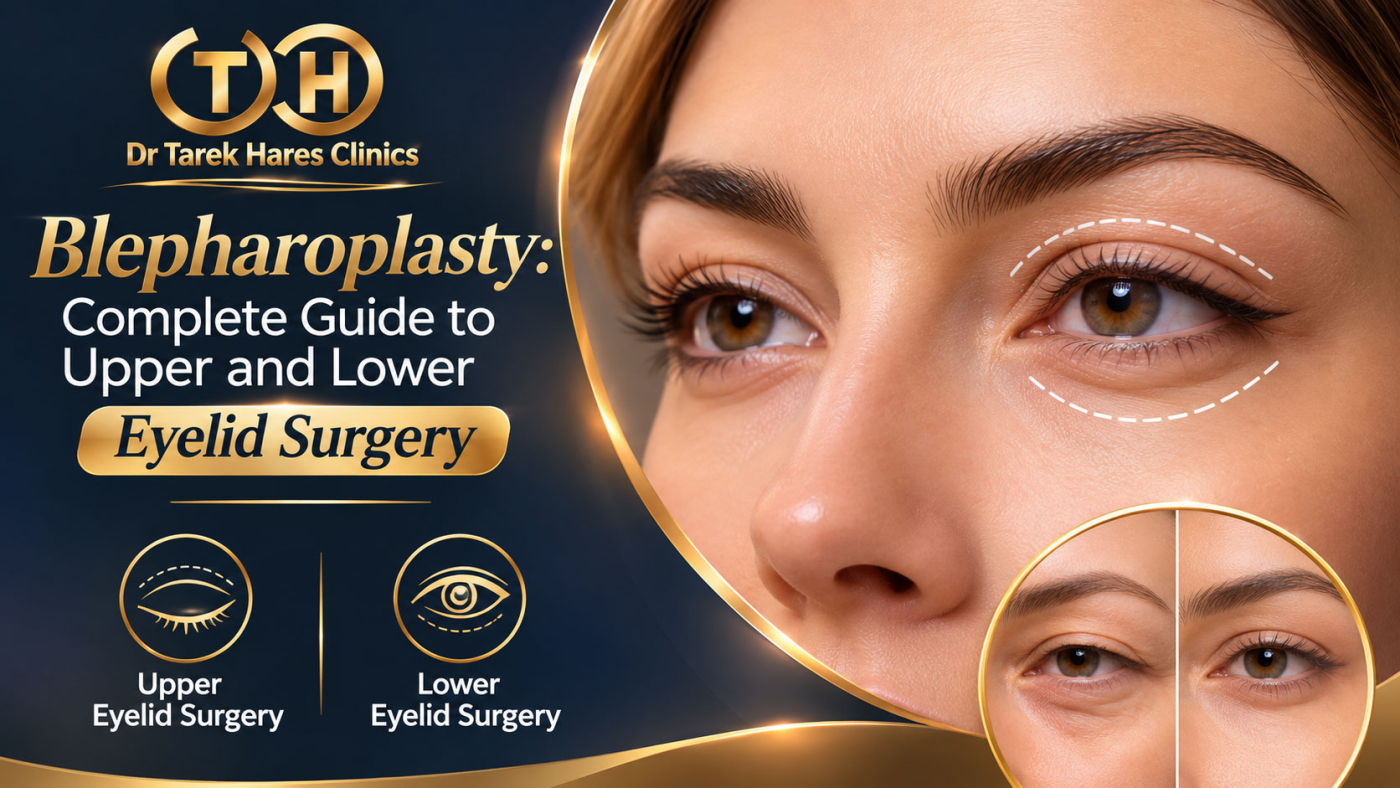
Blepharoplasty: The Complete Guide to Upper and Lower Eyelid Surgery
The eyes are one of the most expressive features of the human face. They communicate emotions, personality, and vitality. However, changes in the eyelids caused by aging, genetics, and environmental factors can make a person appear tired, older, or less energetic than they actually feel.
Excess eyelid skin, puffiness, prominent fat deposits, and drooping eyelids are among the most common concerns affecting the appearance of the eye area. In some patients, these changes can also interfere with vision and everyday activities.
Blepharoplasty, commonly known as eyelid surgery, is a specialized surgical procedure designed to address excess eyelid skin, selected fat deposits, and other age-related changes around the eyes.
Depending on the patient’s anatomy and concerns, surgery may involve the upper eyelids, lower eyelids, or both.
Dr. Tarek AbdelHaris provides specialized eye and eyelid aesthetic care, focusing on individualized treatment planning and preserving the natural appearance and function of the eyes.
In this comprehensive guide, we explain everything you need to know about blepharoplasty, including its indications, surgical techniques, recovery, potential complications, and how to determine whether you may be a suitable candidate.
What Is Blepharoplasty?
Blepharoplasty is a surgical procedure performed to improve the appearance or function of the upper and/or lower eyelids.
The procedure may involve removing or repositioning excess skin, carefully managing protruding orbital fat, and addressing selected supporting tissues according to the patient’s anatomical needs.
There are two main types:
- Upper eyelid blepharoplasty: Addresses excess skin and selected tissue changes affecting the upper eyelids.
- Lower eyelid blepharoplasty: Addresses under-eye bags, protruding fat, and selected skin and contour changes beneath the eyes.
Some patients benefit from combining both procedures to achieve a more balanced appearance.
Importantly, blepharoplasty is not the same as ptosis surgery. A patient with a drooping eyelid caused by weakness or stretching of the eyelid-lifting mechanism may require a different operation.
Why Do People Need Eyelid Surgery?
Several factors contribute to changes in the eyelids.
1. Natural aging
As people get older, the skin gradually loses elasticity. Supporting tissues may weaken, and fat around the eyes can become more prominent or change position.
These changes can produce:
- Excess upper eyelid skin.
- Deep upper eyelid folds.
- Puffiness beneath the eyes.
- More noticeable lower eyelid wrinkles.
- A tired or aged appearance.
2. Genetic factors
Some individuals develop prominent upper eyelid skin or under-eye bags at a relatively young age.
This may be related to inherited facial anatomy, orbital fat distribution, and skin characteristics.
3. Changes in orbital fat
Fat naturally surrounds and protects the eyeball. With aging and changes in supporting structures, some fat compartments may become more prominent.
This can contribute to the appearance of upper or lower eyelid puffiness.
4. Medical and functional problems
Excess upper eyelid skin can sometimes interfere with the upper visual field.
Patients may notice difficulty with reading, driving, or other activities that require an unobstructed field of vision.
A proper eye examination is important to determine whether the problem is caused by excess skin, true ptosis, brow descent, or a combination of these conditions.
Types of Blepharoplasty
1. Upper Eyelid Blepharoplasty
Upper eyelid blepharoplasty is designed to address excess skin and selected tissue changes affecting the upper eyelids.
During the procedure, the surgeon makes an incision within the natural upper eyelid crease whenever appropriate.
The surgical plan may involve:
- Removing carefully measured excess skin.
- Managing selected fat deposits when indicated.
- Preserving adequate eyelid tissue.
- Creating or refining the natural eyelid crease.
- Maintaining proper eyelid closure and function.
The objective is not simply to remove as much skin as possible. The surgeon must preserve sufficient tissue to allow comfortable blinking and complete eyelid closure.
Who may benefit?
Patients who experience:
- Heavy or hooded upper eyelids.
- Excess skin resting on the eyelashes.
- A tired appearance caused by redundant eyelid skin.
- Reduced upper visual field due to excess skin.
- Age-related changes in upper eyelid contour.
2. Lower Eyelid Blepharoplasty
Biplanar Contour-Oriented Approach to Lower Eyelid and Midface Rejuvenation – Tanuj Nakra, 2015
Lower eyelid blepharoplasty focuses on improving the appearance of the area beneath the eyes.
It may address:
- Prominent under-eye fat pads.
- Lower eyelid skin laxity.
- Selected wrinkles.
- Uneven transitions between the lower eyelid and cheek.
- Age-related changes in lower eyelid contour.
Two commonly used approaches include:
Transcutaneous approach
An incision is made just below the lower eyelashes. This approach may be suitable when excess skin needs to be addressed along with deeper tissue changes.
Transconjunctival approach
An incision is made on the inner surface of the lower eyelid. It can provide access to protruding orbital fat without an external skin incision.
This approach is particularly useful in selected patients who have under-eye bags but do not have significant excess skin requiring removal.
The appropriate technique depends on skin elasticity, fat distribution, eyelid position, and the relationship between the lower eyelid and cheek.
3. Combined Upper and Lower Blepharoplasty
Some patients have concerns affecting both the upper and lower eyelids.
In these cases, a combined procedure may be considered after evaluating the patient’s general health, eye condition, anatomy, and surgical goals.
Combining procedures does not automatically make the result better. The decision should be based on clinical indications and patient safety.
What Are the Benefits of Blepharoplasty?
The potential benefits depend on the patient’s condition and the surgical technique.
Cosmetic benefits
- A more refreshed and rested appearance.
- Improved upper eyelid definition.
- Reduction in prominent under-eye bags.
- Smoother eyelid contours.
- Better harmony between the eyelids and surrounding facial structures.
Functional benefits
For patients whose excess upper eyelid skin interferes with their visual field, appropriately indicated surgery may improve vision-related daily activities.
However, cosmetic blepharoplasty does not correct every cause of reduced vision. A complete eye examination is necessary.
Who Is a Good Candidate for Blepharoplasty?
A suitable candidate is someone whose concerns can be addressed by eyelid surgery and whose expectations are realistic.
Candidates may include adults who:
- Have excess upper eyelid skin.
- Have prominent lower eyelid bags.
- Experience age-related eyelid changes.
- Have good general health or appropriately managed medical conditions.
- Understand the possible benefits and limitations of surgery.
Certain conditions require additional assessment, including:
- Dry eye disease.
- Thyroid-related eye disease.
- Previous eyelid surgery.
- Eyelid malposition.
- Bleeding disorders.
- Use of anticoagulant medications.
- Problems with eyelid closure.
Patients should provide their surgeon with a complete medical and medication history.
How Is Blepharoplasty Performed?
The surgical plan is individualized.
Step 1: Consultation and examination
The surgeon evaluates:
- Eyelid skin quality.
- Fat distribution.
- Eyelid position.
- Eyebrow position.
- Tear film and ocular surface.
- Eyelid closure.
- Existing asymmetry.
- Previous eye procedures.
Photographs may be taken to document the patient’s initial anatomy and assist with surgical planning.
Step 2: Anesthesia
Depending on the procedure, patient factors, and surgical plan, local anesthesia with sedation or general anesthesia may be used.
Step 3: Surgical markings
The surgeon identifies the appropriate incision locations and determines how much tissue can be safely treated.
Step 4: Surgical correction
Excess skin may be removed, and fat may be removed or repositioned when clinically appropriate.
The surgeon aims to preserve the natural anatomy and avoid excessive tissue removal.
Step 5: Closure and postoperative care
Incisions are closed using appropriate sutures. The patient receives specific postoperative instructions and a follow-up schedule.
Recovery After Blepharoplasty
Recovery varies between individuals and depends on the extent of surgery.
| Recovery stage | What patients may experience |
|---|---|
| First 24–72 hours | Swelling, bruising, mild discomfort |
| First week | Gradual improvement in swelling and bruising |
| 1–2 weeks | Many patients feel more comfortable returning to routine activities |
| Following weeks | Bruising and residual swelling continue to improve |
| Following months | Scars and tissues continue to mature |
These are general estimates, not guaranteed recovery times.
Important postoperative instructions
Patients may be advised to:
- Use cold compresses according to the surgeon’s instructions.
- Keep the head elevated when resting.
- Avoid strenuous exercise during the initial recovery period.
- Avoid rubbing or pressing the eyes.
- Use prescribed eye drops or ointments.
- Attend all scheduled follow-up appointments.
- Protect the eyelid area from excessive sun exposure.
Do not stop prescribed medication or change blood-thinning treatment without consulting the prescribing physician and surgeon.
Important: Sudden vision changes, severe eye pain, rapidly increasing swelling, or significant bleeding after surgery require immediate medical assessment.
What Are the Risks and Complications of Blepharoplasty?
Like all surgical procedures, blepharoplasty has potential risks.
Possible complications include:
- Swelling and bruising.
- Infection.
- Bleeding.
- Scarring.
- Temporary dry eye symptoms.
- Difficulty closing the eyelids.
- Eyelid asymmetry.
- Changes in eyelid position.
- Overcorrection or undercorrection.
- Need for revision surgery.
- Rare but serious orbital hemorrhage and vision loss.
A careful preoperative assessment, appropriate surgical planning, and postoperative monitoring help manage these risks.
How Long Do Blepharoplasty Results Last?
Results can be long-lasting, but eyelid surgery does not stop the natural aging process.
The duration of improvement depends on:
- Age.
- Skin quality.
- Genetics.
- Lifestyle.
- Surgical technique.
- Individual healing characteristics.
Some patients enjoy the results for many years without needing additional surgery.
However, natural aging continues after the procedure.
Is Blepharoplasty the Same as Ptosis Surgery?
No.
This distinction is particularly important.
Blepharoplasty addresses excess eyelid skin and selected tissue changes.
Ptosis surgery corrects a low upper eyelid margin caused by a problem with the eyelid-lifting mechanism.
A patient may have both conditions and require a combined or staged surgical approach.
The correct diagnosis must be established before treatment.
Frequently Asked Questions About Blepharoplasty
1. Is blepharoplasty a painful procedure?
Discomfort varies. Most patients experience some swelling, tightness, and mild discomfort during the initial recovery period. The surgical and anesthesia teams provide appropriate pain-management instructions.
2. How long does eyelid surgery take?
The duration depends on whether upper eyelid surgery, lower eyelid surgery, or both are performed, as well as the complexity of the case.
3. Will blepharoplasty leave visible scars?
Incisions are generally placed in natural eyelid creases or on the inner surface of the lower eyelid when appropriate. Scars usually mature over time, but their appearance varies.
4. Can blepharoplasty improve vision?
It may improve the upper visual field when excess upper eyelid skin is obstructing vision. It does not correct all vision problems.
5. Is blepharoplasty suitable for younger patients?
Some younger patients may benefit when inherited anatomy causes prominent eyelid skin or fat. Age alone does not determine suitability.
6. Can upper and lower eyelid surgery be performed together?
Yes, in selected patients following appropriate examination and surgical planning.
7. When can I return to work?
Many patients return to non-strenuous activities within approximately one to two weeks, depending on their recovery and the nature of their work.
8. Does blepharoplasty remove dark circles?
Not necessarily. Dark circles may result from pigmentation, thin skin, vascular visibility, hollowing, or shadows. Blepharoplasty treats selected structural causes, not every type of dark circle.
9. Can eyelid surgery be repeated?
Revision surgery may be considered in selected cases, but it requires careful evaluation of existing scars, tissue availability, eyelid position, and ocular surface health.
10. How do I know whether I need blepharoplasty or ptosis surgery?
An examination by an appropriately trained eyelid surgeon is necessary to determine whether the problem is excess skin, a low eyelid margin, brow descent, or a combination.
Why Choose Dr. Tarek AbdelHaris for Eyelid Surgery?
Eyelid surgery requires more than an understanding of facial aesthetics. The surgeon must also understand eyelid anatomy, tear-film function, blinking, eyelid closure, and the relationship between the eyelids and the eye itself.
Dr. Tarek AbdelHaris focuses on eye surgery and eyelid aesthetics, with an individualized approach to assessing each patient’s needs.
The treatment plan should prioritize:
- Accurate diagnosis.
- Detailed eyelid assessment.
- Appropriate surgical technique.
- Preservation of eyelid function.
- Natural-looking aesthetic goals.
- Careful postoperative follow-up.
Book Your Blepharoplasty Consultation
If excess eyelid skin, heavy upper eyelids, or under-eye bags are affecting your appearance or daily activities, a specialist examination can help determine the most appropriate treatment.
Book a consultation with Dr. Tarek AbdelHaris to discuss your eyelid concerns and explore your treatment options.
A wonderful serenity has taken possession of my entire soul, like these sweet mornings of spring which I enjoy with my whole heart. I am alone, and feel the charm of existence in this spot, which was created for the bliss of souls like mine. I am so happy.
my dear friend, so absorbed in the exquisite sense of mere tranquil existence, that I neglect my talents.
I feel that I never was a greater artist than now. When, while the lovely valley teems with vapour around me, and the meridian sun strikes the upper surface of the impenetrable foliage of my trees, and but a few stray gleams steal into the inner sanctuary.